In the High-PressureVessels (HPV) Laboratory at Wroclaw Uniwersity of Technology it is possible to make the different hydraulic tests of high-pressure vessels for CNG and Hydrogen storage:
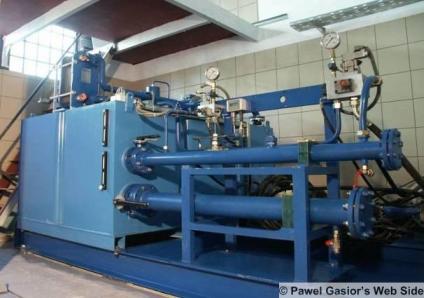
In the Laboratory of High-Pressure Vessels tanks can be hydraulically cycled at ambient and extreme temperatures using the specific procedure (in accordance with the standards, i.e. ECE Compressed Gaseous Hydrogen Regulation).All experiments are realized with the use of the unique hydraulic set-up. Before the tests vessels are filled with non-corrosive working fluid – oil.
The tanks can be also fully equipped with different sensors to record vessels’ behavior. Different types of sensors can be used. From conventional strain and stress gauges to optical fibers with Bragg gratings (FBG). AE sensors (Acoustic Emission) can also applied to monitor fiber and/or matrix breakings and correlate with other signals.
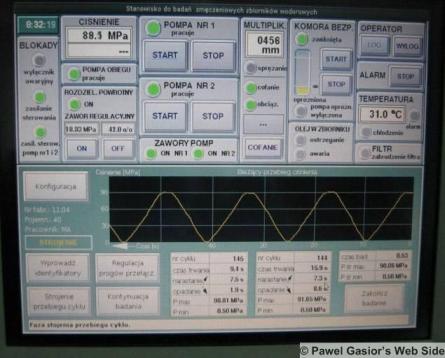
Hydraulic equipment for cycling tests Control touch-panel
Test characteristics:
Max. cyclic pressure: 1100 bar
Min. cyclic pressure: < 20 bar
Number of cycles: < 10 cycles / min (depending on vessel capacity, cyclic pressure, etc.)
Working medium: oil
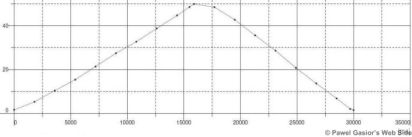
Typical pressure-time curve (20-500 bar)
Shape of the pressure-time curve can be modified. During the whole cycle increase and decrease time of the pressure is controlled.
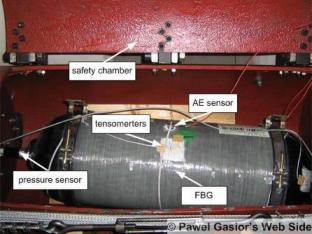
Vessel with all sensors in the safety chamber
Extreme Temperature Pressure Cycling Test
Test conditions are in agree with the hydrogen regulation ECE Compressed Gaseous Hydrogen Regulation. Dimensions of the climatic chamber are: 2m x 2m x 3m
Test characteristics:
Min.chamber temperature: - 52° C
Max.chamber temperature: + 90° C
Max.humidity: 100%
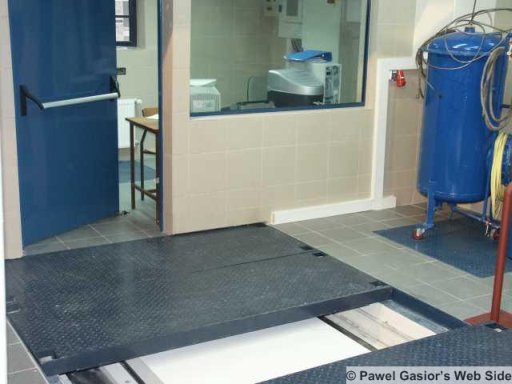
Climatic chamber (white door under navy flaps)
Back to top|Back to Cycling Test
In our Laboratory of HPV tanks can be hydraulically burst tested at ambient temperature using the specific procedure (in accordance with the standards, i.e. ECE Compressed Gaseous Hydrogen Regulation).The experiments are realized at ambient temperature with the use of burst set-up, which is made of an air driven liquid pump. The vessels are filled with non-corrosive working fluid (water) and degassed.According to the regulation the Burst Pressure shall exceed the Nominal Working Pressure times the Burst Pressure (i.e. 1645 bar for high-pressure vessels made from carbon-epoxy composite) and the rate of pressurization shall be ≤14 bar/s.
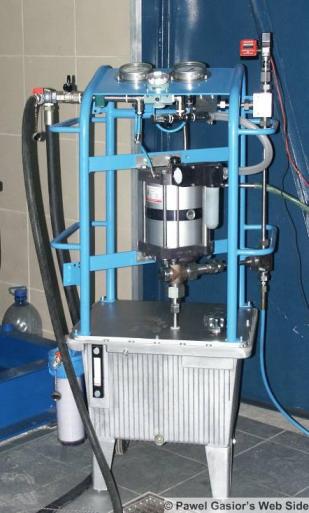
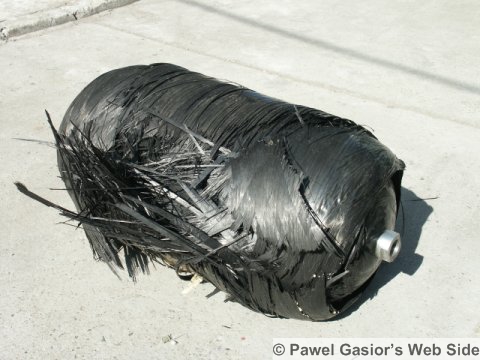
Burst pump Composite high-pressure vessel for H2 storage after burst test
Tests characteristics:
Max. test pressure: 3000 bar
Rate of pressurization: 5 bar/s
Working medium: degassed water
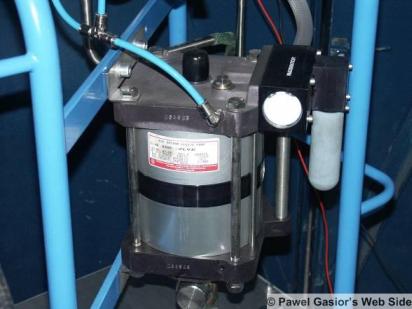
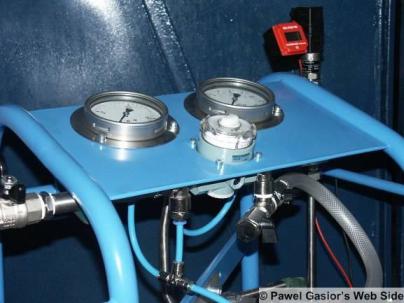
Pneumatic engine Control panel
Back to top|Back to Cycling Test|Back to Extreme Tests